A PBS mind in an MTV world. Anonymous

Showing posts with label ferry. Show all posts

Thursday, October 05, 2006

Malaysia -- Day 2 -- Taman Negara National Park


After a short "overnight" stay of 4 hours at Hotel Sri Emas in Jerantut, I had a long overdue shower and got ready at 8.00 am for my trip to Taman Negara. At 130 million years old, it is one of the oldest (and largest) living rain forests in the world. It became a protected region in 1939 and has since become one of the most popular destinations for ecotourism in Malaysia. I went to the NBK travel agency and made reservations that included bus transfer to Tembeling pier, 3-hour ferry rides to and from Taman Negara, a visit to Orang Asli (Malaysian aborigine village) and finally a bus ride from Jerantut to KL. The travel agency was very nice and the folks very helpful. The total cost of my Taman Negara stay was 130 MYR. Over breakfast, I met again the French couple, Nicholas and Marianne.

The bus ride was very comfortable and at the Tembeling pier we used the restroom, because for the next 3 hours there was going to be no opportunity. Plenty of bottled water was at hand and necessary. The ferry ride was very relaxing and refreshing, but after two hours, we were itching to set our feet on solid ground. Upon arrival in Taman Negara, Nicholas, Marianne and I checked into Tahan guest house, a strenuous 10 minute walk from the pier. There were no individual rooms, so we shared a room with bunk beds at 10 MYR per night per guest. Tahan guest house is a sweet little cottage run by Muslims. Their custom forbids alcohol usage inside the rooms and no footwear was allowed either. I felt very much at home and I shall definitely be returning there.

I had lunch (12 MYR) at the pier (a Malayan fish curry with rice and coconut juice). I had chosen to see the Orang Asli village (orang = old in Malay, asli = real) at 3.30 pm. I wanted to do the very popular canopy walk. Typically, this is a group activity and a guided tour, but since I was running out of time, I rented a ferry (40 MYR) and went bravely to do this.

Normally, the canopy walk takes 20 minutes across one of the most exciting suspended bridges in the world. I stepped off the ferry, and instead of turning left, I turned right. A colossal mistake! I ended up walking alone in the rain forest through relatively empty paths for an hour. I usually enjoy a strenuous trek, but this wasn't the time or the place for it and I ran out of -- gasp -- drinking water. I was sweating profusely, my throat was parched and I was tired. To top it all, the signs are really, really poor. Anyway, I stumbled around desperately looking for a path to the river bank and once I found it, I reached the water joyously and waited for a ferry to pick me up. I was 2 km upstream from my purported drop-off point and was literally "up a shit creek without a paddle". After an interminable half-an-hour, a flagged down a ferry and the local fisherman took me back to the drop off point. Communicating with him was a problem. My ferry took me back to the landing, and my "savior" had a big laugh at my expense with his buddies. God knows what they told each other!

I rested a few minutes, drank drink plenty of water and joined the group visiting the Orang Asli. The aborigines reminded me of the Todas I had seen many years ago in Ooty, South India. Our guide spoke good English and gave us a glimpse into their history, lifestyles and habits. We learned (a little) to make fire using rattan fiber, a piece of hardwood and bamboo shavings, to use a blowpipe and to drink water from branches cut from trees. Survival skills in the jungle apparently. Interesting stuff! The aborigines were very friendly but there was no way to communicate with them.

I had a set dinner of a vegetarian soup, chicken satay and a whole grilled fish (14 MYR) at a riverside restaurant. Excellent! At 9.00 pm, I joined a night safari that took us in open-air jeeps through palm tree plantations. I met a young Dutch couple this time, Nicolas and Eti. We were outside for an hour-and-a-half, but all we saw were a couple of owls and leopard cats -- these leopard cats were more cats than leopards. It was nice to be out in the open, though, with fresh breeze in our faces, mitigating somewhat the hot night air. It was a long, hectic day and I went to sleep immediately.

Wednesday, September 20, 2006

Hong Kong -- Macau, Day 2


I woke up early and set out for Macau, the oldest Portuguese (and European) colony in China, now under the jurisdiction of the People's Republic of China. I had heard about Macau, the casinos, its rising prosperity (24,000 USD per capita income), increasing tourism from Mainland China and Hong Kong, the food and the renowned banking industry, etc. -- I wanted to experience it firsthand. From a historical standpoint, Macau traded extensively with the British East India Company (later British Raj). Portugal, in the meanwhile, controlled parts of India in the 17th and 18th centuries. In 1498 AD, Vasco da Gama discovered the trade routes to India and made parts of East and South Asia accessible to European colonial powers. As they say, the rest is history. Incidentally, Macau lies 70 km(43 miles) southwest of Hong Kong and is best reached by ferry.

I had breakfast (sausage and eggs) at the Ferry terminal near Cheung Wan MTR, a terrible mistake. Avoid sausage in Hong Kong -- it tastes really bad and looked like no other sausage I had ever eaten. To get to Macau use one of the many ferry operators between Hong Kong and Macau. The ferries run every 20 minutes or so. I took the TurboJet Ferry at a cost of 140 HKD (~ 16 USD); there is a first class @ 240 HKD. The trip is an hour long each way and pass through Hong Kong emigration as well as Macau immigration. Upon arrival, I took a 2 1/2 hour walking tour of the Macau peninsula suggested by Lonely Planet. I took the walk and was happy to get a feel for the city, from the new and the old to the weird and typical. I had mentioned in my previous posting that the "ladder streets" in Hong Kong were fast disappearing; Macau still has them.

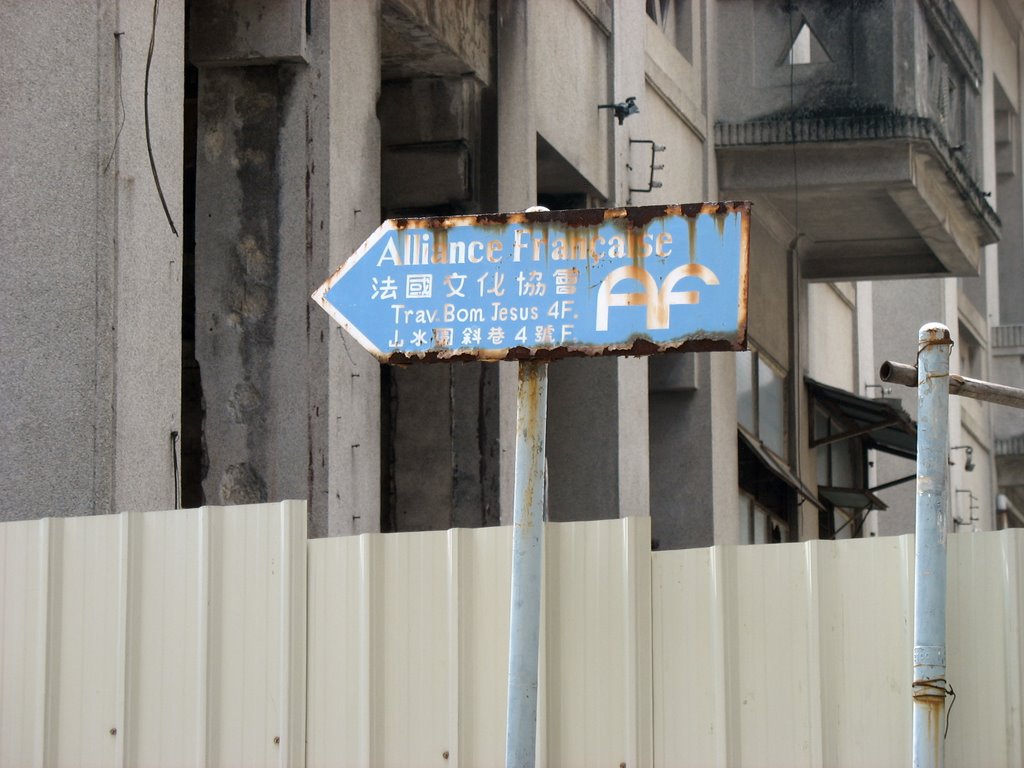
Macau's casinos, financial districts and governmental buildings are connected by wide, paved streets, while the commercial and the residential areas are narrow, winding and sometimes steep. All street signs are in Portuguese and in Chinese, however, you'll have a hard time finding anyone that speaks Portuguese or English, for that matter. Portuguese has little or no significance to the people in their daily life today, perhaps only some official types speak it. You will still see a lot of Western influence in the architecture, though. Right in the middle of the alleyways, I found an Indian restaurant, something that I never expected as well as a signboard pointing to an Alliance Française of Macau. Wonders will never cease.

I visited the very informative and interesting Macau Museum, passed through the various shopping districts similar to those in Hong Kong. The final stop in my 3 hour walk was lunch at the highly recommended A Lorcha, very close to the A-Ma Temple. This restaurant carries traditional Portuguese cuisine. I had a sopa de marisco (seafood soup), porco balichao tamarino (pork with tamarind and shrimp paste) washed down with an excellent oporto (port wine). The lunch tab was 160 Macanese pataca or MOP$; MOP$ is pegged to the Hong Kong dollar.

With a few hours to kill, I hopped over to the Taipa village, which, to my chagrin, was a waste of time. Avoid it! To get around, I used the excellent public transport system in Macau. The signs and directions are neatly marked and the cost was approximately 2.5 MOP$ a ride. I also peeked into a couple of casinos -- Golden Casino and the newly opened Wynn casino. According to Wikipedia, the Macanese casinos have revenues greater than those of Las Vegas. Imagine that! Many more casinos are expected to open over the next couple of years.

After a long and tiring day, it was time take the one hour ferry ride back to Hong Kong. I took the subway back to Wang Fat Hostel, and I managed to get the crazy Korean guy moved to another room. Good riddance! I met my new roommates, Arnold from Taiwan and Rod from Calgary, really nice guys. Since I was feeling a tired and satiated from all the food, I had a couple of fruits and some yogurt and called it a night.

Hong Kong MTR: The subway system is fantastic, frequent and easy to use. All signs are in English and Cantonese. A typical ride is 10 HKD (~ 1.25 USD). MTR is huge and reaches the all the important parts of Hong Kong. There is no graffiti to speak of and cellphones work even underground. You can purchase an all day pass on the MTR for 50 HKD (~7 USD) and travel between Hong Kong Island, Kowloon as well as Lantau Island, the home of the new Disneyland Resort. BART in comparison is dirty, expensive, infrequent and overrated. Whoever called BART the number one public transportation system in the US has not seen the subway system overseas. We've a lot to learn from them.